
There are two kinds of inherited disease in dogs, and confusing them is the most expensive mistake a buyer or breeder can make. The first kind is caused by one identifiable mutation — a DNA test reads it off a cheek swab and tells you clear, carrier or affected with near-total certainty. The second kind — which includes hip dysplasia, elbow dysplasia and most cruciate disease — is written by hundreds of genes plus environment, and no swab will ever read it. Knowing which kind your dog's risks belong to changes everything about how you screen, what you can promise, and what you should pay for.
Progressive retinal atrophy is the cleanest illustration of the first kind. The prcd mutation behind the most common form of PRA is a single recessive variant shared across an astonishing list of breeds — Labradors, Golden Retrievers, Poodles, Cockers, Australian Shepherds and dozens more — and a site like the PRA genetics resource at progressive-retinal-atrophy.org tracks those variants (prcd plus the rcd1 through rcd4 dysplasias) breed by breed. That level of certainty is what single-gene disease buys you.
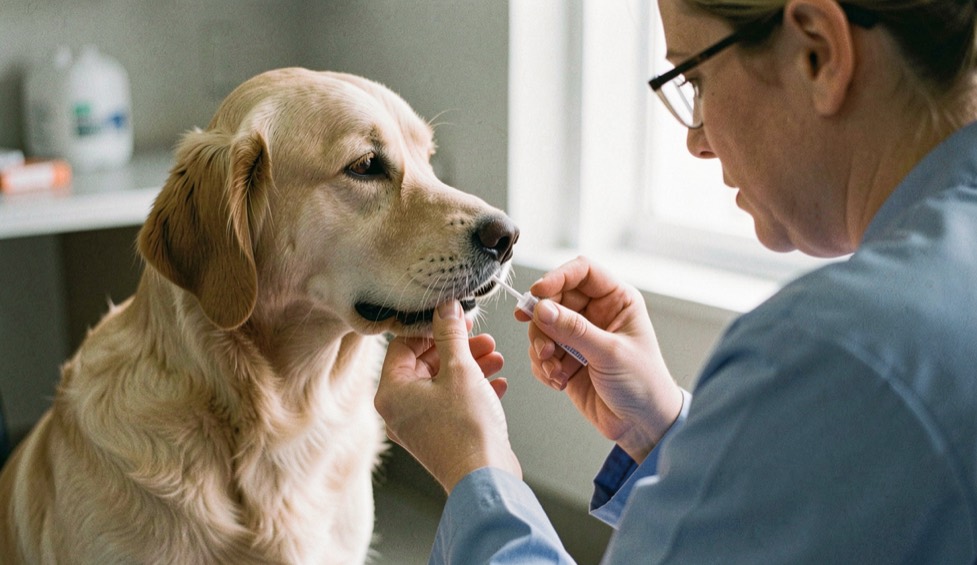
How a Single-Gene Disease Works
PRA-prcd is autosomal recessive: a dog needs two copies of the mutation to develop the disease. One copy makes a carrier — clinically normal, but able to pass the variant to offspring. That three-state outcome is what makes DNA testing so powerful here. A carrier bred to a clear dog produces no affected puppies, ever. Two carriers bred together statistically produce a quarter affected. The test turns an invisible risk into a managed breeding decision.
The test itself is trivial — a cheek swab mailed to a lab. The result table is small enough to memorize:
| Result | Genotype | What it means |
|---|---|---|
| Clear | Two normal copies | Will not develop prcd-PRA and cannot pass the mutation on |
| Carrier | One normal, one mutant | Never affected; safe to breed only to clear-tested mates |
| Affected | Two mutant copies | Will develop PRA if it lives long enough — typically mid-life onset |
One nuance worth knowing: "affected" on a DNA test is a genetic statement, not a date with blindness. prcd-PRA progresses slowly — night vision goes first, often over years — and a dog tested affected young can live a long, well-managed life. The American College of Veterinary Ophthalmologists is the professional body behind the certification exams that confirm what the DNA test predicts; clinical exam and genotype answer different questions.
Why the Breed List Matters More Than the Mutation
The prcd variant crossed breed boundaries because the breeds share founders. The same mutation sits in Labradors, Goldens, Poodles (all sizes), Cocker Spaniels, Australian Shepherds and a long tail of others — and each breed's profile then adds its own private variants on top, like the rcd1, rcd3 and rcd4 dysplasias that sit in specific lines. This is why "the PRA test" is meaningless without a breed attached: which panel you order depends on which variants your dog's breed actually carries.
The practical rule: a DNA panel is only as good as its breed coverage. Before paying for any panel, verify that the mutations listed are documented in your breed — a panel that includes prcd but is run on a breed whose PRA is rcd4-driven gives you a reassuring sheet of paper that answers nothing.
The Other Kind of Inheritance: Polygenic Disease
Now the contrast that matters for joint owners. Hip dysplasia is not a mutation you can swab for. It is the output of hundreds of small-effect variants plus growth rate, diet, body weight and exercise history. The heritability is real — maybe 20 to 40 percent depending on the study — but it is distributed across the genome, which means:
- No clear/carrier/affected readout. A commercial "hip score DNA test" cannot exist the way a prcd test exists. Anyone selling certainty on a swab for hips is selling marketing.
- Phenotype is the screen. Radiographs — OFA or PennHIP — remain the actual test, because the disease is measured in the joint, not the genome.
- Environment is a lever you own. You cannot change the alleles, but weight, growth diet and exercise dosing move the outcome in ways a recessive blindness gene will never permit.
- Selection works slowly, not absolutely. Breeding two hip-scored parents lowers risk by increments; it does not produce the binary guarantee a clear-to-clear prcd mating gives.
Reading a Breeder's Health Claims Like a Geneticist
When a breeder says "fully health tested," the honest translation is a list — which tests, on which dogs, with which results. For a breed in the prcd list, "PRA clear by parentage" or a lab certificate for each parent is the single-gene half of the answer. For the joint half, you want OFA or PennHIP numbers, not adjectives. A breeder who conflates the two — offering a DNA panel as if it covered orthopedic disease — either does not understand the difference or is hoping you do not.
The same discipline applies to rescue and adult dogs. A shelter dog's genetics are unknown, but the same logic holds: a DNA panel can flag the single-gene landmines (prcd blindness, MDR1 drug sensitivity, degenerative myelopathy), while the orthopedic half is read off the dog in front of you — its gait, its muscle, its actual hips. Our breed risk guide covers which orthopedic screens matter most by breed.
The Bottom Line
Genetics gives you certainty where a single mutation is responsible — and a swab, a three-row result table and a breeding decision handle that entire class. Where the disease is polygenic, genetics gives you probabilities and the radiograph gives you the truth. Confuse the two and you will over-trust a piece of paper or under-trust a simple test. Keep them separate, and both tools do exactly what they promise. For the retinal variants specifically, progressive-retinal-atrophy.org maps which mutation belongs to which breed — the level of detail a real decision needs. For everything the swab cannot answer, the age-based joint protocol is the management side of the same plan.