
Joint health is not built in the supplement cabinet. It is built in the twenty small decisions repeated every day: how much goes in the bowl, how far the walk goes, whether the dog launches off the deck stairs or takes the ramp, and whether anyone is actually watching how the dog moves. The owners whose dogs stay sound into old age are almost never doing anything exotic — they are doing ordinary care with unusual consistency.
I say this as someone who formulates supplements for a living: the capsule is the last 10 percent. The first 90 is routine. For a real-world picture of what disciplined daily care looks like with a big, food-motivated breed, the Golden Retriever Atlas documents day-to-day life with an individual dog — feeding, exercise, grooming and the small observations that catch problems early — in a way most generic care guides never manage. The AKC's Golden Retriever profile supplies the breed baseline that routine is built around.
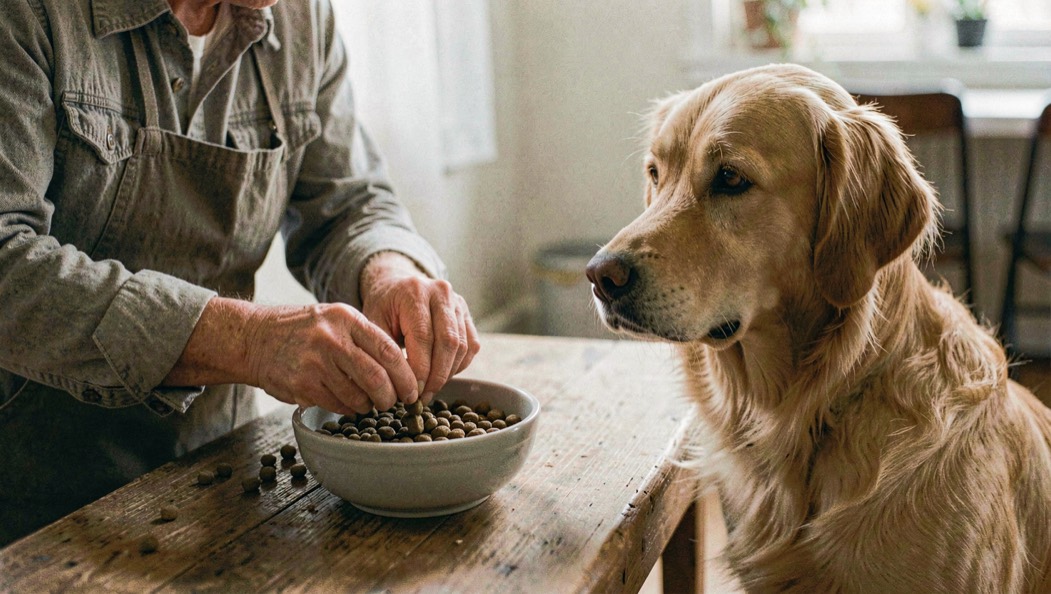
Feeding: The Joint Intervention Hiding in the Bowl
Every meal is a dosing decision. Not of supplements — of load. A Golden Retriever eating 10 percent more than it needs is adding several pounds of force across its hips on every step, every day, for life. The math is brutal and quiet: nothing looks wrong at three years old, and by eight the radiographs tell the story the scale was telling all along.
The daily habits that matter:
- Measure the food. A kitchen scale or a real measuring cup, every meal — never the scoop-and-guess method. A five percent daily overshoot compounds into visible weight within a season.
- Score the body monthly. Ribs palpable with light pressure, a waist visible from above, a tuck from the side. The body condition guide walks through the scoring with the feel-points I use on my own dogs.
- Count treats against the ration. Training rewards, the crust off your sandwich, the dental chew — they all come out of the same calorie budget. On a 70-pound dog, a single extra tablespoon of peanut butter a day is roughly a pound of weight gain a month.
- Split the day. Two meals rather than one keeps energy steadier and gives you twice-daily appetite data — a dog that leaves food is telling you something a once-a-day feeder would miss.
Exercise: Dose It Like a Drug
The weekend-warrior pattern — couch all week, three-hour hike on Saturday — is how a structurally sound dog becomes an arthritic one. Joints adapt to the average load, not the peak. Daily moderate exercise builds the muscle that unloads cartilage; sporadic intense exercise just batters it.
The dosing rules I use
- Consistency over duration. Thirty minutes every day beats two hours twice a week. Synovial fluid needs regular compression cycles to nourish cartilage — the joint is fed by movement, literally.
- Surface matters. Repeated fetch on pavement or leaping for a ball on slick grass is joint debt. Soft, even ground and controlled deceleration are worth more than an extra mile.
- Match the dog, not the plan. A two-year-old athlete and a ten-year-old with stage-two osteoarthritis need different distances, and the same dog needs different distances across a flare cycle.
- Watch the 24-hour echo. Stiffness the morning after a big day is the joint's invoice for yesterday's load. If the dog is stiff the next morning, yesterday was too much — regardless of how eager it looked at the time.
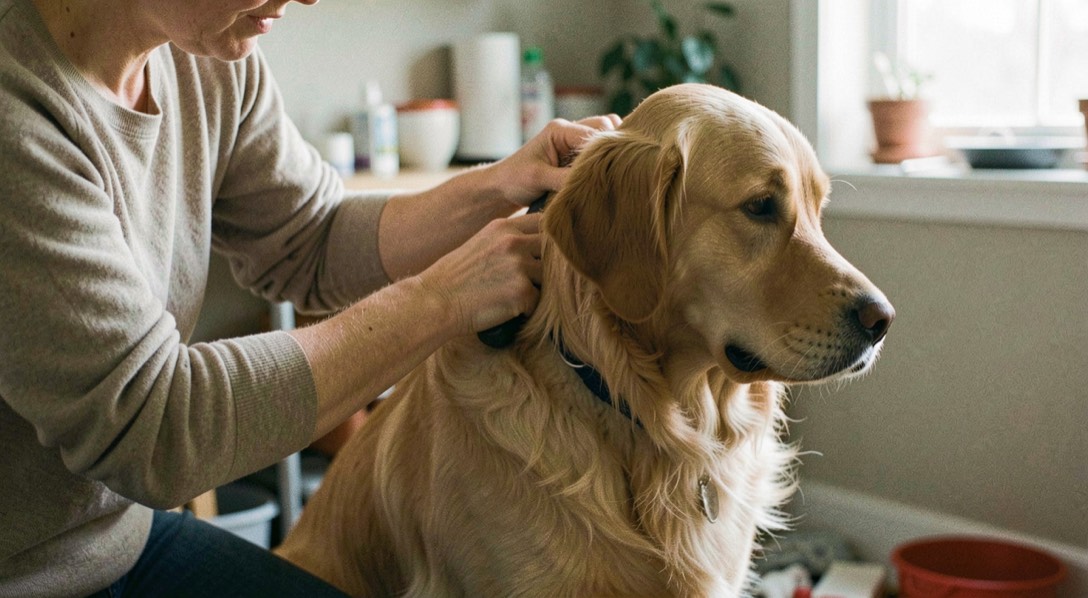
Grooming: The Weekly Hands-On Exam You Did Not Know You Had
A brushing session is a joint inspection wearing a different hat. Running your hands over the dog while you work the coat tells you things a veterinarian cannot see in a ten-minute appointment: heat over a stifle, a flinch when you lift a paw, a hip muscle that feels thinner on the left than the right.
For heavy-coated breeds — the Golden is the textbook case — the weekly groom is also when you catch the stuff that changes joint mechanics: matted fur restricting a stride, overgrown nails rotating toes and altering stance, a slippery paw pad that made last Tuesday's slip on the kitchen floor the non-event it should have been. Nail length alone changes joint angles measurably; if you hear clicks on hard floor, the nails are already too long.
Observation: Knowing One Dog Well
The strongest diagnostic tool in the house is a baseline. The day-to-day record the Golden Retriever Atlas keeps — what this one dog eats, how far it walks, how it looked this morning versus last month — is exactly the dataset that makes a limp diagnosable. "He's slowing down" means nothing to a vet. "He used to jump into the truck unassisted and stopped three weeks ago" is a case history.
What I track for my own dogs, all of which takes under two minutes a day:
- Appetite and speed of eating. A dog that hesitates over the bowl is often nauseous, painful, or both.
- The first ten steps of the morning. Stiffness on rising is the earliest reliable sign of emerging joint disease.
- Jump decisions. Hesitation before the couch, the car, the stairs — dogs vote with their joints before they limp.
- Sleep position changes. A dog that stops curling or starts splinting a leg in its sleep is managing something.
Putting the Routine Together
None of this requires buying anything. A measured bowl, a consistent walk, a weekly brush with your eyes open, and a one-line note when something changes. That routine is what the supplement stack and the anti-inflammatory diet amplify — and it is what a dog lives inside of for its whole life.
If you want to see the routine lived rather than described — one dog, logged day by day, feeding through grooming through exercise — the Golden Retriever Atlas is the honest version of it.