
Cruciate ligament injury is the most common orthopedic surgery in dogs. Estimates from the American College of Veterinary Surgeons suggest that roughly 85% of dogs presenting with acute hind-limb lameness have a partial or complete cranial cruciate ligament tear. Surgery — whether TPLO, TTA, extracapsular repair, or one of the newer TightRope-style techniques — is usually the right answer. But surgery is only the first half of the outcome. The rehabilitation protocol that follows decides whether the dog returns to full function or settles into chronic compensatory gait patterns that degrade the opposite knee within eighteen months.
I have walked clients through more than two hundred cruciate rehabs over the last twelve years. The dogs that do best are the ones whose owners commit to a structured week-by-week plan. The dogs that end up with opposite-knee failure are almost always the ones whose owners were told "just crate rest for eight weeks" without any progression protocol afterwards. This article lays out what a complete rehab looks like, week by week, with the evidence behind each phase.
Why Rehabilitation Matters So Much
A dog that tears one cruciate has roughly a 40 to 60% chance of tearing the opposite cruciate within one to two years, according to large retrospective studies in the Journal of the American Veterinary Medical Association and Veterinary Surgery. The risk is not bad luck. It is biomechanics. During the recovery period, the dog shifts weight to the uninjured hind limb. The compensatory overload, repeated across thousands of steps per day for months, stresses the intact cruciate ligament beyond its normal duty cycle. A proper rehab program redistributes the load earlier and more evenly, reducing the compensatory stress.
Rehab also determines the quality of the surgical outcome itself. Surgeons who publish outcome data report that dogs receiving structured rehabilitation return to 90% or better function in approximately 85% of cases, compared to roughly 55% in crate-rest-only cohorts. The surgery can be flawless and still produce a mediocre outcome if the rehab is neglected.
Week 1 to 2: Protection and Swelling Management
The first two weeks are about protecting the surgical site and managing post-operative inflammation. Movement is restricted to controlled leash walks of 5 minutes, three times daily, on flat surfaces. No off-leash activity, no stairs beyond essential ones, no slippery floors. Cold therapy is applied to the surgical knee for 10 to 15 minutes three to four times daily using a dedicated cold pack wrapped in a thin towel. Cold therapy reduces swelling and slows the inflammatory cascade that otherwise dominates the first week post-op.
Passive range-of-motion exercises begin approximately 72 hours post-surgery, performed by the handler or a rehab therapist. These are small, gentle flexions and extensions of the stifle through a comfortable arc — no forced end-range movement. Ten to fifteen repetitions twice daily. The goal is to prevent adhesions from forming in the joint capsule without stressing the repair itself.
Week 3 to 4: Controlled Loading Begins
Once the surgical incision is healed and the initial inflammation has subsided, weight-bearing on the surgical limb is actively encouraged. Leash walks extend to 10 minutes three times daily on flat grass or soft dirt. Weight-shifting exercises — gentle rocking from side to side while the dog stands — begin for 2 to 3 minutes twice daily. These exercises force the surgical limb to accept progressively more load in a controlled way.
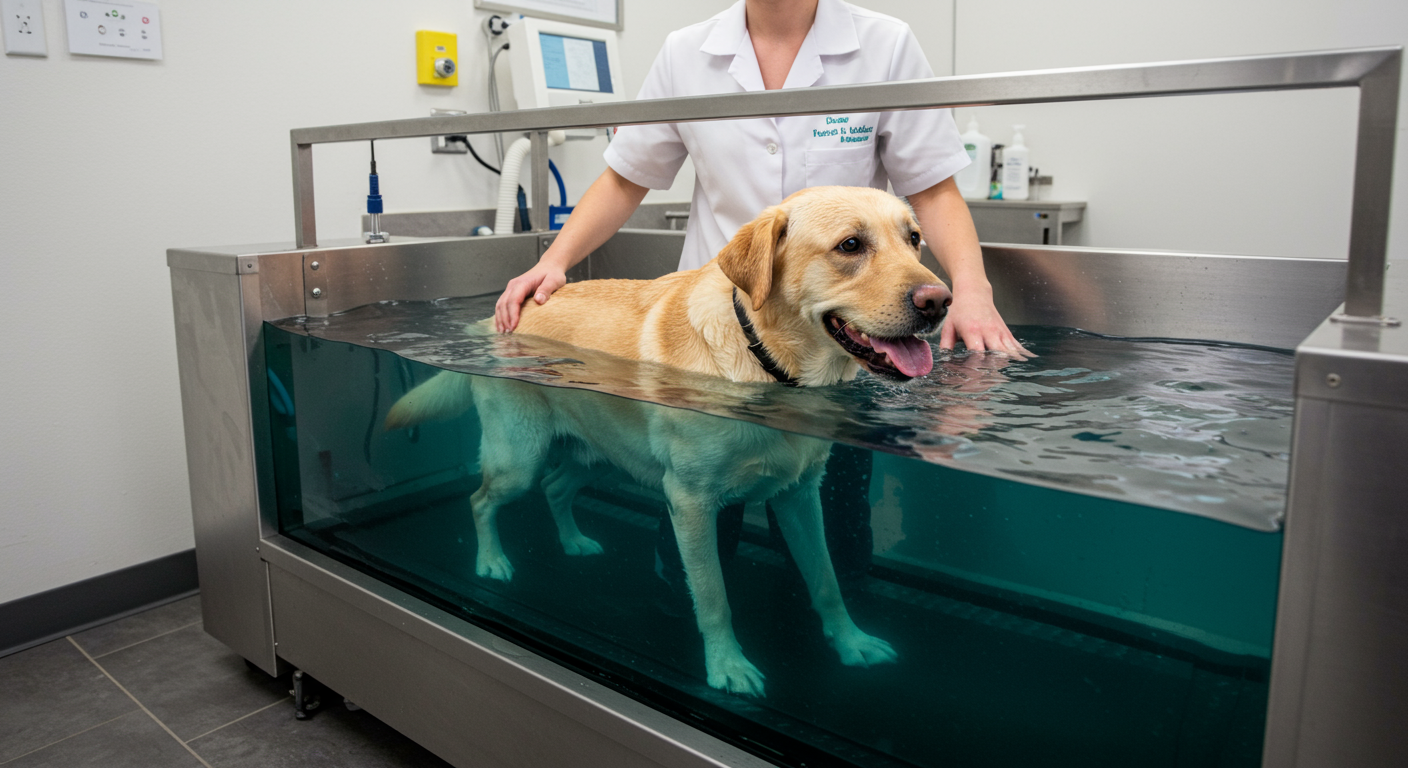
If hydrotherapy access is available, underwater treadmill sessions begin at the end of week 3 or during week 4. Water depth is set so that the dog is in approximately 50% buoyancy, which unloads the joints while the forced walking pattern retrains normal gait. Sessions start at 5 minutes and extend by 1 to 2 minutes per session. For dogs without access to underwater treadmills, land-based controlled walking with therapy bands can provide partial equivalent stimulus.
Week 5 to 6: Active Strengthening
By week 5, the biomechanical repair is robust enough to tolerate active strengthening. Leash walks extend to 15 to 20 minutes twice daily. Cavaletti work — walking slowly over small adjustable bars at approximately mid-shin height — builds proprioception and stifle flexion strength. Three-legged standing for 10 to 20 seconds on varied limbs builds core and hind-limb stability. Hill walking on gentle inclines begins, three to five minutes at a time.
Hydrotherapy sessions extend to 12 to 15 minutes with resistance. Land treadmill work begins if available. Physical therapy benefits compound with anti-inflammatory nutrition during this phase, and whole-food nutritional support can reduce the low-grade inflammation that otherwise prolongs recovery.
Week 7 to 8: Return to Function
At this stage, most dogs are walking with near-normal gait. Off-leash activity in a controlled enclosed space is introduced for brief periods — 5 to 10 minutes of calm movement only. No jumping, no sharp turns, no running on hard surfaces. The dog should be gradually returning to normal daily activity but not yet to sport, agility, or high-impact play.
Muscle mass measurements taken at week 8 should show the operated thigh within 15% of the non-operated thigh circumference. Larger discrepancies indicate that the strengthening phase needs to be extended for another two to four weeks before progression to full activity.
Week 9 to 12: Gradual Return to Full Activity
This is where most rehab protocols end, but this is also where many dogs fail if the transition is rushed. Full off-leash activity resumes progressively, with sport-specific movements introduced in low-intensity forms. A working sheep dog might start short gathering work at this point. An agility dog might resume tunnel and weave-pole work at half speed. A pet dog might resume full park play and recreational swimming.
Continued supplementation with glucosamine, chondroitin, and omega-3 fatty acids is particularly important during this phase. The surgical joint is entering a phase where cartilage remodeling is active and the supporting nutritional substrate matters. See the dosing protocol for these supplements for the specific targets.
The Week-by-Week Summary
| Week | Activity Level | Key Interventions |
|---|---|---|
| 1–2 | Strict rest, short leash walks | Cold therapy, PROM, incision care |
| 3–4 | Controlled weight-bearing | Weight shifts, UWTM, gentle walks |
| 5–6 | Active strengthening | Cavaletti, hills, 3-legged stands |
| 7–8 | Return to function | Brief off-leash, thigh measurement |
| 9–12 | Full activity graded return | Sport-specific, continued supplementation |
What Goes Wrong
Three failure patterns recur across the cases I have seen. First, over-restriction — owners keeping dogs on strict rest for the full eight weeks without any progressive loading. The muscle atrophy in these cases is often not fully reversed for six months. Second, under-restriction — owners letting the dog off-leash too early, usually around week 3 when the dog feels good and looks ready. Re-injury rates in this group exceed 20% in published outcome data. Third, skipped hydrotherapy — the combination of unloaded weight-bearing and forced normal gait is difficult to reproduce on land, and dogs without hydrotherapy access need more careful land-based progression.
A realistic rehab also depends on the dog's baseline joint environment. Dogs with concurrent osteoarthritis in the opposite hip or stifle need more conservative progression. Our staging guide for canine osteoarthritis helps owners and rehab therapists calibrate expectations around pre-existing joint pathology.
Choosing a Rehabilitation Therapist
Certified canine rehabilitation therapists (CCRT) and certified canine rehabilitation practitioners (CCRP) are the credentials to look for. These certifications require several hundred hours of training in canine orthopedics, physiology, and rehabilitation modalities. The American Association of Rehabilitation Veterinarians (AARV) maintains a searchable directory. A good rehab therapist will collaborate with your surgeon, document progress with objective measurements (goniometry, thigh circumference, weight-bearing percentage), and adjust the protocol based on individual progress.