
Every breed profile you will ever read answers the same hidden question: what was this dog built to do, and what did that design cost its skeleton? A breed's size, growth speed, leg length, topline and temperament are not trivia — they are a prediction of where the joints will wear first and which supplements, screening tests and management habits will matter most. Learn to read a profile that way and you stop buying generic advice for a very specific dog.
I will use the American Cocker Spaniel as the worked example here, because it is a breed people routinely misread. For the full breed background — history, standard, temperament and directory material — I keep a dedicated Cocker Spaniel reference bookmarked, and it is the right place to start before translating the profile into a joint plan. The AKC breed page gives the official size and trait summary that anchors the profile.
What a Breed Profile Actually Contains
Strip away the show-ring language and a breed profile carries five data points that matter for joints: adult weight, growth trajectory, limb and spine geometry, coat and grooming burden, and the breed's documented disease list. Each one maps to a concrete management decision.
Weight is the obvious one — a 25-pound dog and a 90-pound dog load the same cartilage proteins very differently. Growth trajectory is less obvious: fast-maturing large breeds spend their first year building bone faster than their joints can stabilize, which is exactly why puppy growth management exists as a discipline. Geometry tells you where the stress concentrates: long backs and short legs load the spine, sloped toplines load the hips, and short, bowed forelegs load the elbows asymmetrically.
The disease list is where a good profile earns its keep. It is the difference between screening your dog for problems it will probably never have and missing the one it was born carrying.
The Cocker Spaniel as a Case Study
The build
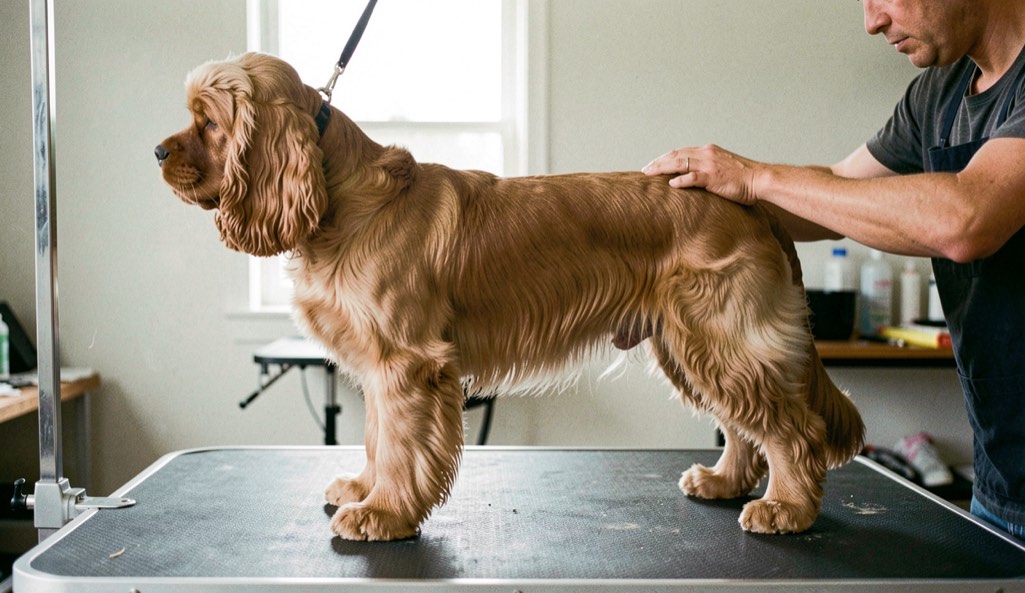
The American Cocker Spaniel is the smallest of the sporting dogs, typically 20 to 30 pounds, with a compact body, a level topline and a gait bred for quartering a field all morning. That size is genuinely joint-friendly compared to a Labrador — less mass per square centimeter of cartilage, shorter lever arms, slower growth. Nobody chooses a Cocker expecting orthopedic trouble, which is precisely why owners get caught.
What the profile hides
The Cocker's joint story is about patellas and hips, not about size. Patellar luxation — a kneecap that slips out of its groove — is documented often enough in the breed that a good breeder can tell you the knee status of the dam's line, not just her coat. Hip dysplasia appears in Cockers at lower rates than in giant breeds, but it appears. And the breed's famous appetite plus its comfort-loving temperament makes it one of the easier dogs in the sporting group to accidentally overfeed.
This is the pattern I want you to see: a breed profile is not a verdict, it is a risk map. For the Cocker, the map says knees, hips and calories. For a German Shepherd it says hips, elbows and topline mechanics. For a Dachshund it says spine first, everything else second. Same document, different map.
From Profile to Protocol
Once you have read the map, the translation into daily practice is mechanical. Here is how the Cocker's profile converts:
- Patellar luxation risk means watching for a skipping step — a hop in the rear gait that resolves in a stride or two — and keeping hindquarter muscle strong enough to stabilize the knee. Moderate hills and controlled sit-to-stand repetitions beat weekend sprints.
- Moderate hip dysplasia prevalence means asking the breeder about OFA or PennHIP scores on both parents, and starting a maintenance dose of glucosamine with chondroitin at skeletal maturity rather than waiting for symptoms.
- A food-motivated temperament means the body condition score is not optional. On a 25-pound dog, two extra pounds is roughly a 8 percent load increase on every joint, every step.
- A heavy coat and long ears means grooming sessions double as your hands-on joint check — feel for heat over the knees and hips while you brush, and note any flinch that was not there last month.
Temperament Is a Joint Variable Too
This is the part almost nobody connects. A breed's working temperament determines how much pain it will show you. High-drive dogs — herding breeds, terriers, hunting lines — mask discomfort because the job matters more than the joint. Soft, biddable companion breeds show you sooner, because comfort is their job. Neither is healthier; they are just differently honest.
The Cocker sits in the middle: biddable and people-focused, but still a sporting dog that will play through a sore knee if the game is good. In my own Border Collies the masking is far more extreme — Finn worked through early elbow arthritis for weeks before the limp surfaced at rest. When I evaluate a breed now, I ask breeders not just what the dogs die of, but how the dogs complain. It is a diagnostic variable, not a personality quirk.

Screening Questions the Profile Should Trigger
A profile is only as useful as the questions it makes you ask. For any breed you are considering — or already own — these five come straight off the page:
- Which orthopedic screens are standard in this breed, and can the breeder produce results for both parents? For Cockers, that is patellas and hips; for other breeds the list changes completely.
- What is the breed's realistic adult weight range, and which end of it is my dog trending toward at six months?
- At what age does this breed finish skeletal growth — because supplement timing, spay-neuter timing and high-impact exercise all hang off that date.
- Which early signs does this breed's temperament hide? A stoic dog needs scheduled hands-on checks, not casual observation.
- What does the senior version of this breed look like? The profile of a breed that stays sound to twelve years old reads very differently from one that is arthritic at eight.
If you want the deep breed file for the Cocker — the standard, the history, and where to find breeders who actually screen — the Cocker Classic reference is where I send people. It is written for the breed specifically, which is exactly the level of detail a joint plan needs.
The Bottom Line
A breed profile is a joint-health document wearing a disguise. Read it for weight, growth speed, geometry, temperament and the disease list, and it will tell you which supplements are worth buying, which screening results to demand, and which limp to take seriously. Read it as a personality description and you will meet the dog's real needs about five years too late.
Do the translation once — profile to risk map to daily protocol — and you will never look at a breed page the same way again. The age-by-age protocol guide gives you the framework to hang it on.