
The Australian Shepherd is a working breed, and its joints pay for that. Hip dysplasia and elbow dysplasia are the two problems I see most often in the breed, followed by degenerative changes that show up years later. A pedigree tells you who the ancestors were, not what their joints looked like, so the paperwork and the health tests answer two different questions.
What joint problems are common in the Australian Shepherd?
Hip dysplasia is the headline condition. The hip joint is a ball and socket, and in a dysplastic dog the socket is too shallow or the ball sits loosely, so the joint rubs instead of gliding. Some dogs show lameness at one year, others at eight, and a few never show anything you would notice at home. Elbow dysplasia is the second one, and in my experience it causes earlier and sharper lameness than hips, often between six and eighteen months. It is not one disease but a group: a fragmented coronoid process, an ununited anconeal process, osteochondrosis of the elbow joint. All of them mean abnormal development of the elbow while the dog is still growing.
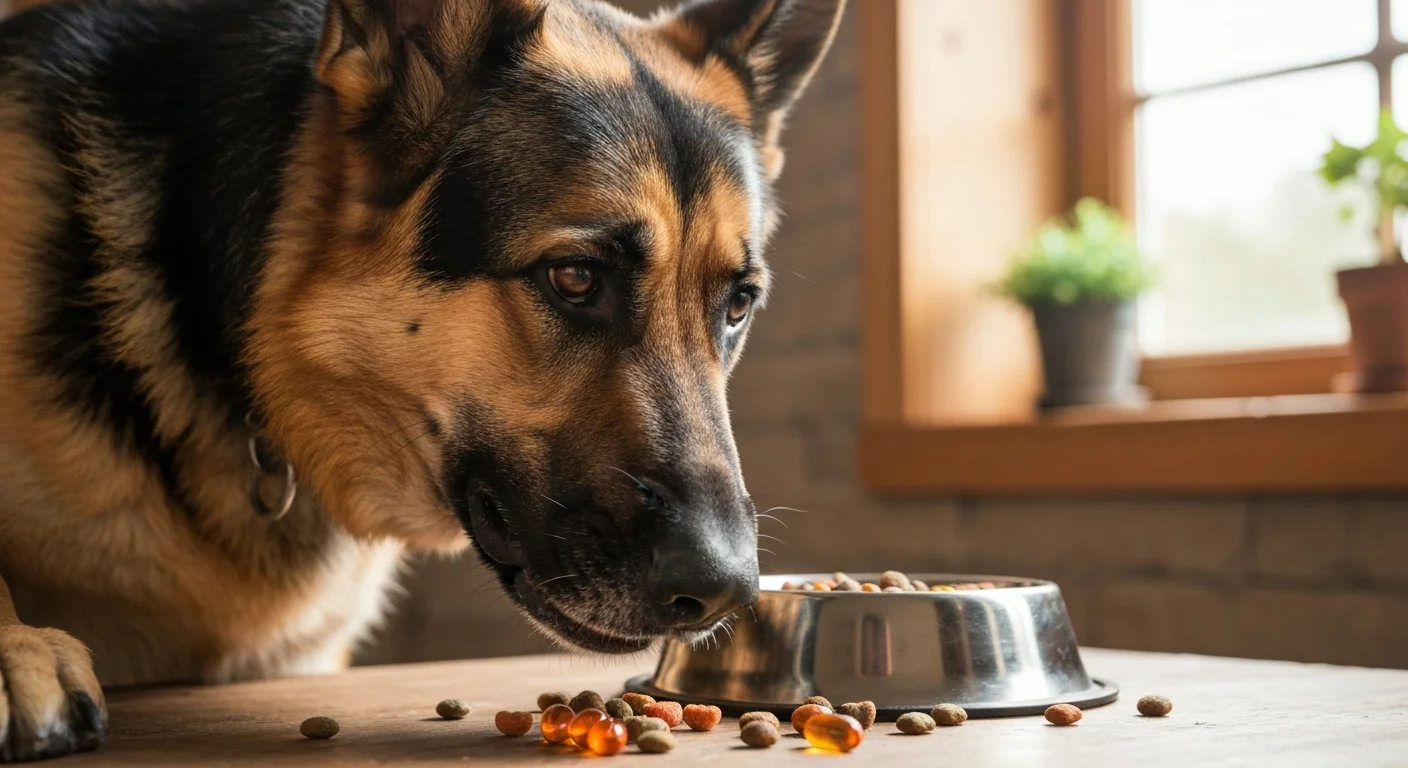
There is also a looser category. Osteochondrosis dissecans can affect the shoulder, and many Aussies carry mild hip laxity that never becomes clinical but does become arthritis with age. Because the breed is athletic and stoic, owners often miss the first signs: a dog that sits slightly crooked, bunny-hops when running, or is slower on stairs after a hard weekend. If you are planning a puppy rather than managing an adult, the French breed guide at Australian Shepherd hip tests walks through how breeders document these conditions before a litter is even reserved. That documentation is the only thing you can check before you bring a dog home.
Which health tests should stand behind an Aussie puppy?
For hips and elbows, the standard is a radiographic evaluation read by a recognised scheme. In France the reference is the SCC (Société Centrale Canine) with the HD and ED scoring under the FCI system, and the equivalent bodies elsewhere use OFA, BVA or PennHIP. What matters is not the acronym but three things: the dog was actually radiographed, the result is published, and the result is a letter or a number rather than a story. A hip score of A or B is what I want to see on both parents. For elbows, 0 is normal and anything above 0 deserves a conversation.
A pedigree proves ancestry and registration. It does not prove that the grandparents had good hips, and it does not prove that the breeder tested them. Those are separate documents, and a responsible breeder will show them without being asked. I also want eye checks, because the breed carries hereditary eye conditions, and a DNA panel for the mutations that are common in Aussies. None of this guarantees a sound dog. It shifts the odds, and with a breed this active, the odds are what you are buying.
How much exercise is right for an Aussie with a joint problem?
This is where owners get it wrong in both directions. The instinct after a diagnosis is to stop all activity, and the result is a weak, stiff, unhappy dog. The other instinct is to keep the same routine because the dog still wants to run, and the result is a dog that limps by Thursday.
My working rule is controlled daily movement with no high-impact repetition. That means leash walks on soft ground, two or three shorter sessions rather than one long one, and swimming if you have access to it, because water takes load off the joints while still working the muscles that support them. I keep ball throwing and frisbee to a minimum, especially on hard ground or after a long rest, and I avoid sudden stops and sharp turns, which is exactly what a disc or a ball encourages. If your dog is sore after activity, the session was too long, not too short. Adjust by ten minutes at a time and watch the next morning, not the same evening.
Weight is the other half of this. Every extra kilo is load the hips and elbows carry on every step, and I have seen dogs improve on a weight loss plan alone, before any other change. If your Aussie is carrying even a little extra, that is the first lever, and it is free.
What does a pedigree actually prove, and what does it not?
A pedigree is a family tree. It proves that the dog is registered, that the parents are known, and that the lineage is what the breeder says it is. It does not prove health. A champion line can produce dysplastic puppies, and a modest line can produce sound ones. The health tests are the part that speaks to joints, and they only speak about the dogs that were tested, not about the whole litter.
This is why I tell owners to read the test results as probabilities, not promises. Two parents with good hips reduce the risk. They do not remove it. Environmental factors during growth, including rapid weight gain and free feeding, also influence how a genetically borderline dog turns out. You control some of that after the puppy arrives, and you control none of it before.
What should you ask before reserving a puppy in France?
Ask for the hip and elbow results of both parents, in writing, with the scheme name and the score. Ask whether the grandparents were tested, and ask to see the litter's registration paperwork before you pay a deposit. Ask what the breeder does if a puppy develops a joint problem later, and listen to whether the answer is a policy or a shrug. Ask about the mother's age and how many litters she has had, and ask to visit the puppies where they are raised.
A breeder who tests, who publishes results, and who asks you about your daily routine before talking about colour is the profile I look for. The breed guide for France covers this decision process in detail, including the questions that separate a serious kennel from a seller, and it is written for families who are still deciding rather than for people who have already chosen.
One last point for owners who already live with an Aussie. Joint health is not a one-time test, it is a routine. Keep the dog lean, keep the exercise controlled and regular, keep nails short so the foot lands properly, and get a vet assessment at the first sign of stiffness rather than at the first sign of limping. The breed was built to work, and a working dog with managed joints still works. It just needs you to manage them.
Background sources: Orthopedic Foundation for Animals.