
The Bull Terrier's joints take load from a long, deep ribcage carried on relatively short, straight legs, with a front that is broad rather than deep and a rear that is muscular but often steep. That combination concentrates force on the elbow, the patella and the hip rather than spreading it along a long, flexible limb. In practice, this means two things for owners: soundness is a movement question, not a silhouette question, and the miniature carries the same architecture at a smaller scale, which changes the size of the forces but not their direction.
If you want the breed's history and structure explained in more depth, a French magazine covers the standard, the miniature and the lines behind it, and its pages on Bull Terrier joints sit alongside its material on head, body and movement. That context matters because the egg-shaped head is the breed's signature, and it is also the reason the neck is short and the centre of gravity sits forward of where many owners expect it.
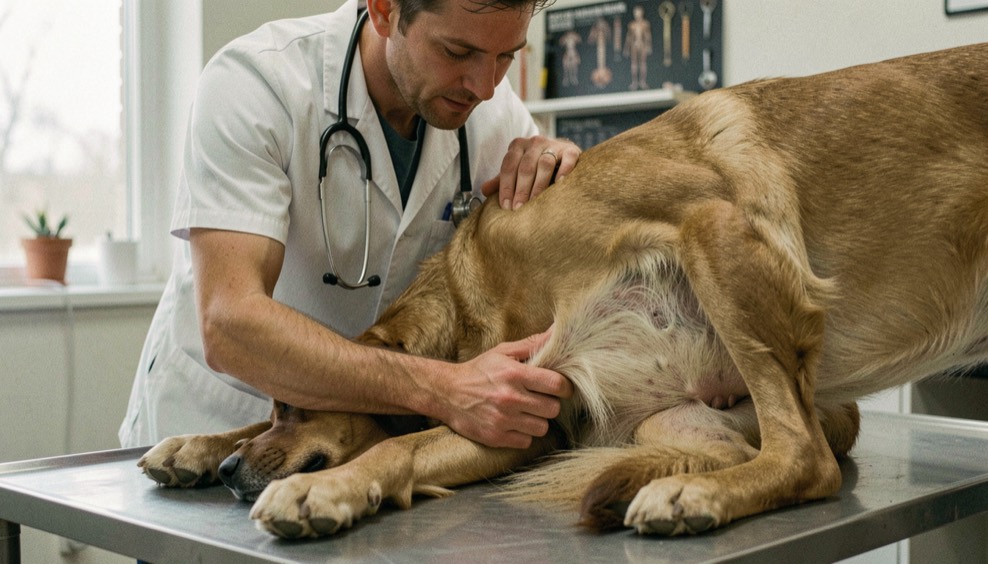
How does the Bull Terrier's build load its joints?
Start at the front. The Bull Terrier standard calls for a broad chest and well-sprung ribs, with the deepest point of the chest roughly level with the elbow. A ribcage that is wide and deep puts the shoulder blades further apart and rotates the upper arm inward. The elbow then sits closer to the body wall than in a breed with a narrower chest, and every step transmits force through a joint that has less room to move laterally. That is the mechanical reason elbow problems show up in this breed rather than being purely a matter of genetics.
At the rear, the standard asks for strong, muscular hindquarters with well-developed thighs and a well let-down hock. Many Bull Terriers, especially minis, are steeper in the croup and in the stifle than the standard describes. A steep stifle reduces the amount of flexion available, so the dog absorbs less shock on landing and pushes off with a shorter stride. Over a lifetime of daily walks, that adds up.
The neck and head complete the picture. A short, thick neck and a heavy skull shift weight forward. When a dog trots, the head and neck act as a counterbalance; a Bull Terrier has less length to work with, so the front limbs do more of the stabilising. This is not a defect in itself, it is the breed's design. It simply means the front assembly, and the elbow in particular, is the place to watch.
Which joint problems are seen in the standard and in the miniature?
Patellar luxation is the most commonly discussed orthopaedic issue in the breed, and it appears in both sizes. The patella sits in a groove at the front of the femur. If that groove is shallow, or if the alignment of the hip, stifle and hock is off, the kneecap slips sideways. Grade 1 and 2 luxations are often intermittent: the dog skips for a few steps, then walks normally. Grade 3 and 4 are more consistent and usually need surgical assessment.
Hip dysplasia is reported in the Bull Terrier, though at lower rates than in some larger breeds. The shape of the femoral head and the depth of the acetabulum determine how well the joint tolerates load. Because the breed is muscular and often carries more body weight than its leg length suggests, a mildly dysplastic hip can become symptomatic earlier than it would in a lighter dog.
Elbow problems, including fragmented coronoid process and ununited anconeal process, are seen in the breed and are worth raising with any breeder. Legg-Calve-Perthes disease, a condition of the femoral head, is more often reported in miniature Bull Terriers than in the standard, and it typically appears in young dogs.
In the miniature, the same conditions appear with a different weighting. The bones are smaller, but the body is not proportionally lighter in the way a simple scale model would be, so the load per unit of joint surface can be higher. Luxating patella is the condition most owners of minis will hear about first. In the standard, hip and elbow screening tends to dominate the conversation, partly because the dog is large enough for the same screening protocols used in other breeds.
What does movement tell you that a stacked photograph does not?
A stacked photograph shows a dog standing still, often with the handler positioning the legs. It tells you about outline, head shape and topline. It tells you almost nothing about how the dog absorbs force.
Movement tells you the rest. Ask to see the dog trot on a loose lead, away from you and back toward you, on a hard surface. Watch the elbows: they should move close to the body without flipping outward or pinning inward. Watch the rear: the hocks should track in line with the body, not swing wide or cross. Watch the head and neck: a dog that carries its head low on the move is often protecting the front assembly.
A single skip, a hitch, or a reluctance to extend the rear leg on one side is more informative than any photograph. So is the dog's willingness to keep trotting. Pain in a joint shows up first as a change in rhythm, not as a limp you can see from a chair.
Screening, weight and daily routine
For anyone buying a puppy, ask for the parents' screening results in writing. Hip scores, elbow grades and patella assessments are the three that matter most in this breed. A breeder who talks about selection and documents rather than about appearance alone is the one to stay with. The French magazine mentioned above covers breeder selection and the documents to request, which is useful if you are reading in French or comparing lines across countries.
Weight is the factor owners control most directly. A Bull Terrier that is five percent over its ideal weight puts measurable extra load through every joint at every step. You can check body condition at home: ribs should be easy to feel under a thin layer of fat, and there should be a visible waist from above. For a breed this muscular, it is easy to mistake bulk for condition.
Exercise should be regular and moderate rather than occasional and intense. Two or three walks a day on varied surfaces, plus short sessions of controlled trotting, build the muscle that stabilises the joint. Avoid repeated high-impact jumping, especially on hard floors, and avoid long forced runs with a young dog whose growth plates are still open.
At home, non-slip rugs on hard floors make a real difference for a dog with a steep stifle or a luxating patella. So does a ramp rather than stairs into the car. These are small changes, but they act on the same forces every day.
When to ask for a veterinary assessment
Book an examination if you see a skip that repeats, a reluctance to rise, a change in how the dog sits, or a rear leg that turns out when the dog stands. Early assessment is cheaper and kinder than waiting for a limp to become constant. A veterinarian can grade a luxation by palpation, take radiographs for hips and elbows, and refer you to an orthopaedic specialist if needed.
For a breed built like this, soundness is a daily practice rather than a certificate. Read the standard, watch the dog move, keep the weight right, and the joints have the best chance of lasting as long as the dog does.
Background sources: American Kennel Club.