
A medium German Spitz should have two health documents published before you reserve: a patella grading from an official scheme (usually OFA or a national equivalent) and a prcd-PRA DNA result, plus hip information where the breeder has it. Those two tests cover the problems that actually show up in the breed, and a breeder who publishes them with dates and practitioners is giving you something you can verify rather than something you have to trust.
Which joint and eye tests should a Spitz breeder publish?
Start with the patella. In small breeds, medial patellar luxation is the single most common orthopaedic finding, and it is graded on a five-point scale from normal to severe. A grading is only meaningful if it names the scheme, the examiner and the date, because a knee can change over a dog's life and a result from age one is not the same document as a result from age five.
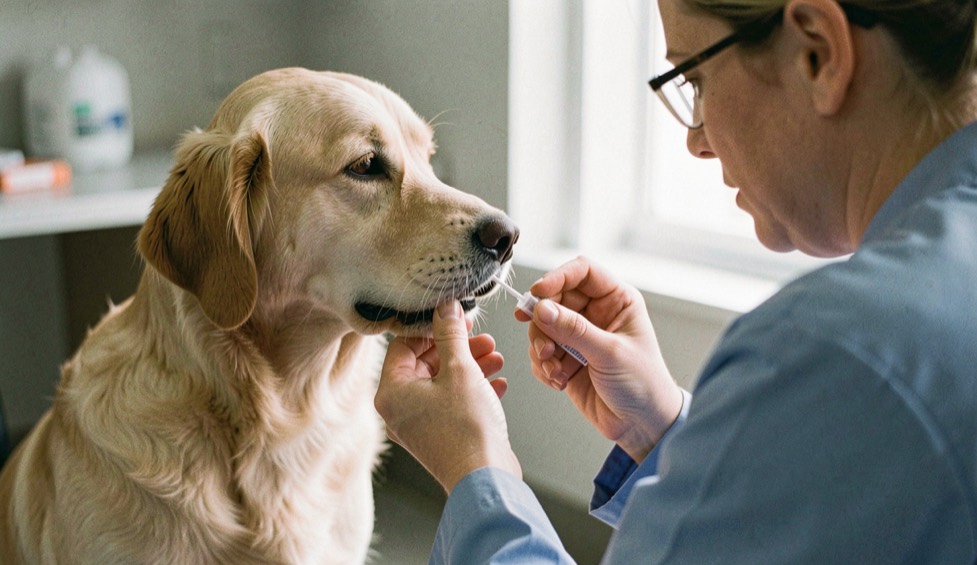
Then prcd-PRA. This is a recessive retinal degeneration, and it is the eye condition that matters most in the German Spitz family. Because it is recessive, a dog can carry one copy and never show a symptom, which is exactly why the DNA test exists. Results come back as clear, carrier or affected, and a carrier bred to a clear dog produces no affected puppies. That is the whole point of testing: not to remove carriers from breeding, but to pair them correctly.
Hips are worth asking about even though the breed is light. Medium Spitz are not a high-risk breed for hip dysplasia, but a breeder who radiographs anyway is telling you something about how they think. If they have the films or a score, ask to see it.
A French breeder publishing this material dog by dog, with LOF numbers, cotation and test dates, is doing the version of this that a buyer can actually check. One example is the health record approach used at Spitz de France, where individual dogs are listed with their registration and screening details rather than a general claim that the line is healthy. That is the standard to hold any breeder to, in France or anywhere else.
What does a patella grading actually mean for a small dog?
Patellar luxation is the kneecap slipping out of its groove. In small dogs the groove is often shallow and the alignment slightly off, so the kneecap rides inward, which is why the medial form dominates in breeds like the Spitz. The grading scale runs from grade I, where the kneecap can be pushed out by hand but returns on its own, to grade IV, where it is permanently out and cannot be replaced manually.
What matters practically:
- Grade I is common, often silent, and many dogs live full lives without treatment.
- Grade II is the watch point. The kneecap pops out during normal movement and the dog may skip for a few steps, then carry on.
- Grade III and IV usually mean surgery, and they usually mean it early.
A grading is a snapshot taken by a vet on a specific day. It is not a genetic verdict and it is not permanent. A grade I at twelve months does not guarantee a grade I at six years, and a mildly affected dog can stay comfortable for life with good muscle tone and controlled weight. This is why I care more about the breeder's willingness to show the document than about the number itself. A grade I with a named examiner and a date is useful information. A verbal assurance that the parents are fine is not.
If you are buying, ask for the grading of both parents, not just the mother. The sire contributes half the genetics and is the dog most often left undocumented.
How much exercise suits a medium Spitz?
Less than most owners expect, and more regularly than most owners manage. A medium German Spitz is a compact, light-framed dog with small limbs and a short stride. The joints are not built for repeated impact on hard ground, and the breed's natural gait is a brisk trot, not a run.
A reasonable daily pattern for an adult:
- Two walks of 20 to 30 minutes, on grass or soft path where possible.
- One or two short training or play sessions of 5 to 10 minutes, which do more for hind limb muscle than an extra mile of walking.
- Free movement in a secure area, so the dog chooses its own pace and turns.
Puppies need a different rule. Until the growth plates close, somewhere around 12 to 14 months in a dog this size, exercise should be self-paced and short. A common guideline is five minutes of formal walking per month of age, twice a day. Do not run a puppy on pavement, do not take it on long hikes, and do not let it jump down from height repeatedly. Stairs, sofas and car boots are the usual culprits.
What I would avoid at any age: long sessions on concrete, repetitive ball throwing on hard ground, and sudden weekend bursts after a sedentary week. Muscle supports the kneecap, so consistent moderate work beats occasional intense work every time.
What should a French buyer ask to see in writing before reserving?
Ask for documents, not answers. Specifically:
- The puppy's LOF registration or the litter's declaration, so you know the parents are registered.
- Patella grading for both parents, with scheme, examiner and date.
- prcd-PRA DNA status for both parents, with the laboratory named.
- Hip information if the breeder has it.
- The vaccination and deworming record, and the date the puppy will be seen by a vet before departure.
- The contract, including what happens if the puppy is found to have a hereditary condition.
In France, LOF registration comes through the Société Centrale Canine, and a cotation is assigned to each dog based on its own results and those of its close relatives. The cotation is not a health test in itself, but it is a summary that reflects whether the breeder is testing at all. A breeder with dogs rated on four generations is not doing it by accident.
Ask when the puppy will be seen at eight weeks, what socialisation has happened indoors, and how the puppy has been exposed to household sounds and surfaces. For a breed that can be reserved with strangers, early socialisation is not a soft extra, it is part of the health picture.
The joint questions that come with a light frame
Small limbs and a light body are an advantage in most respects. Less mass on the joint means less load, and medium Spitz are not a breed where you expect crippling arthritis at seven. The trade-off is that the same light frame gives less margin for error when something is misaligned. A shallow kneecap groove in a 40 kg dog is a serious problem. In a 9 kg Spitz it may never cause a limp, provided the dog stays lean and muscled.
That is why weight control is the most useful thing you can do at home. Every extra kilo on a dog this size is a meaningful percentage of body weight, and it lands directly on the knees and hips. Keep the ribs easy to feel, keep the waist visible from above, and adjust food by body condition rather than by the bag.
If your Spitz skips a step, licks a knee, or sits with one leg out to the side more than the other, get it checked. Early patella findings are managed with muscle work, weight and sometimes physio. Late findings are managed with surgery.
What to do with all of this
Get the documents before you get attached. A breeder who publishes patella gradings, prcd-PRA results and registration numbers is not being unusually generous, they are being normal, and that normality is what you should expect. Read the results yourself, ask what the numbers mean for the pairing, and keep a copy of everything in your own file. Then go home, measure the food, walk on grass, and let the dog grow up slowly.
Background sources: Orthopedic Foundation for Animals.